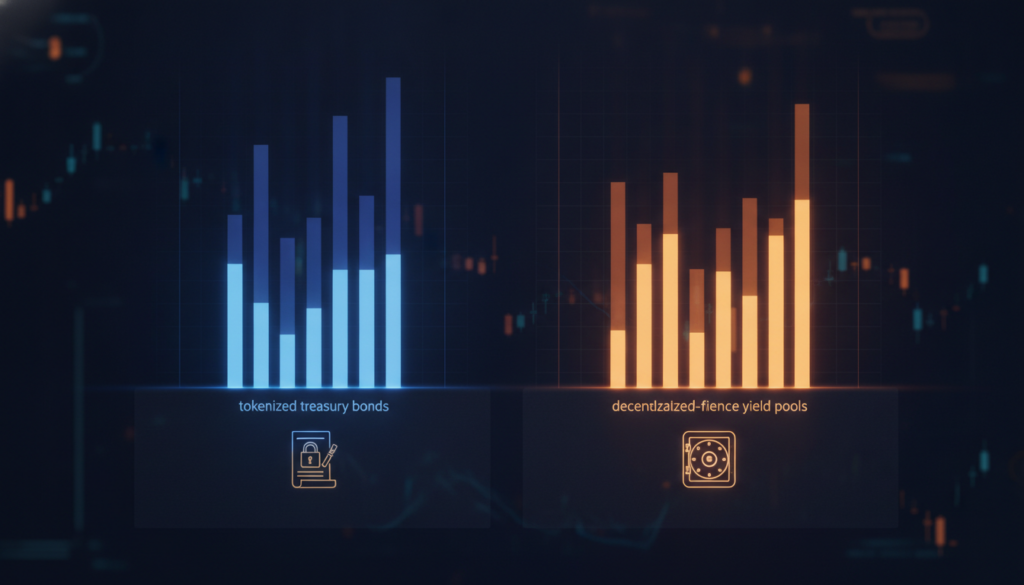

Decentralised finance’s total value locked (TVL) — the most widely-cited measure of capital deployed across DeFi protocols — crossed $150 billion in June 2026, reclaiming levels last seen during the peak of the 2021 cycle. Unlike 2021’s TVL, which was heavily inflated by yield farming ponzinomics, the current composition shows a meaningfully different profile: longer-duration deposits, real-world asset collateral, and institutional treasury participation.
Aave V4: The Institutional Entry Point
Aave’s V4 protocol introduced a “unified liquidity layer” — allowing isolated risk pools with shared capital — and this single architectural change unlocked institutional borrowing at scale. Corporate treasuries that couldn’t accept commingled credit risk in V2/V3 now have a protocol primitive that satisfies risk departments. Aave V4 holds approximately $32B TVL as of June 2026, making it the largest single DeFi protocol.
- Top collateral types: ETH (liquid staking tokens), wBTC, tokenized US Treasuries
- Top borrowing assets: USDC, USDT, GHO (Aave’s native stablecoin)
- Average supply APY on USDC: 4.2% — competitive with TradFi money markets
Uniswap V4: The Hook Revolution
Uniswap V4’s introduction of “hooks” — custom smart contract logic that can trigger on liquidity events — has spawned an ecosystem of specialised liquidity managers. Professional market makers now build custom hooks that implement concentrated liquidity rebalancing, dynamic fee tiers, and MEV capture. Volume on Uniswap V4 exceeded $8B/week within four months of its launch.
“DeFi V4 protocols feel different — there’s real institutional money that doesn’t leave when prices drop.” — r/defi thread on TVL composition analysis
RWA Collateral: The Hidden TVL Story
Approximately $12B of the $150B TVL consists of tokenized real-world assets (tokenized Treasuries, money market funds, tokenized credit). This creates a new form of on-chain liquidity that doesn’t require crypto believers — it requires yield-seekers who happen to be using blockchain rails. BlackRock’s BUIDL fund alone contributes over $2B in on-chain collateral.
Risks in the Current TVL
Despite the healthier composition, risks remain: smart contract exploits (DeFi lost ~$480M to hacks in 2025), oracle manipulation, and regulatory uncertainty around non-custodial lending. The r/CryptoCurrency security thread tracks active exploit alerts. DeFi security firm Chainalysis estimates that 72% of 2025 DeFi losses came from cross-chain bridge exploits — reinforcing the thesis that bridge risk is the industry’s most material attack surface.