
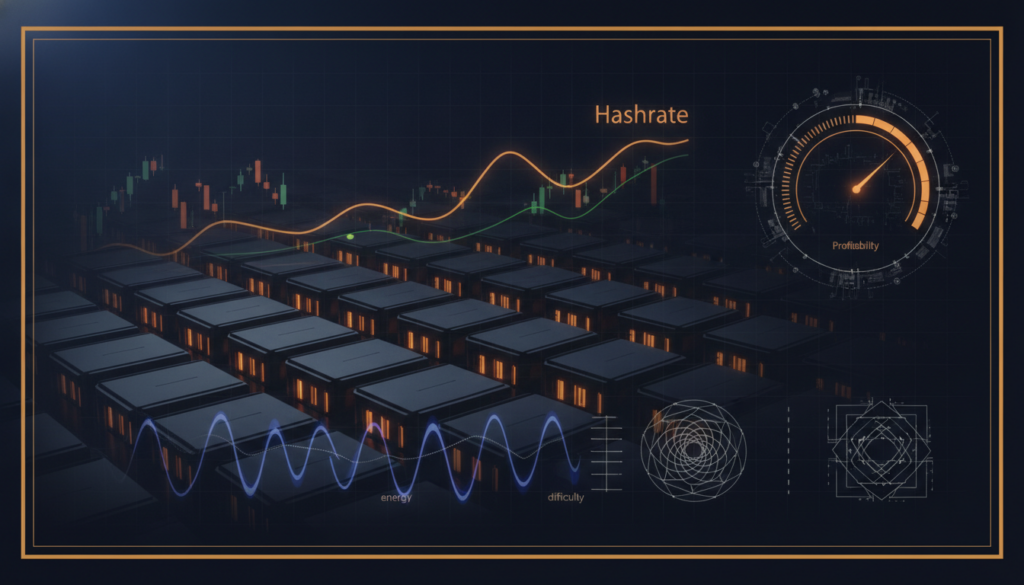
The April 2024 Bitcoin halving dropped the block subsidy from 6.25 BTC to 3.125 BTC — meaning the same hash rate now earns half the new-issuance revenue. With BTC trading near $63,000, the question isn’t whether mining is profitable, but which miners are profitable and by how much.
The Break-Even Math
Mining profitability hinges on three variables: electricity cost ($/kWh), hardware efficiency (J/TH), and Bitcoin price. At current network difficulty and $63K BTC:
- $0.03/kWh (hydro/stranded gas): profitable even on older S19 Pro hardware (~29 J/TH)
- $0.05/kWh (average US industrial): requires S19 XP or newer (21.5 J/TH)
- $0.07/kWh: requires next-gen ASIC (S21, M60S) to remain above breakeven
- $0.10/kWh (residential US average): unprofitable on any commercial hardware
The Hash Rate Signal
Global Bitcoin hash rate hit a new ATH above 900 EH/s in June 2026, suggesting the industry is not capital-constrained. New-generation ASICs from Bitmain (S21 Hydro, 5,360W at 335 TH/s) and MicroBT (M66S) have driven efficiency improvements that allowed large-scale miners to expand capacity despite the reduced subsidy.
The r/BitcoinMining community tracks daily hash rate, pool distribution, and equipment efficiency. Active discussion on post-halving economics includes real data from home miners and industrial operators.
Who Is Actually Profitable?
Winning operations:
- Marathon Digital (MARA): operates at ~$0.04/kWh average across diversified sites
- CleanSpark: Texas + Wyoming footprint with long-term power agreements below $0.045/kWh
- Riot Platforms: benefits from ERCOT demand response credits that effectively reduce net power cost below $0.03/kWh during curtailment events
Under pressure: smaller operations on spot electricity without hedging, and anyone still running S19j Pro or older hardware at mid-tier power costs.
Transaction Fees: The Long-Term Lifeline
As block subsidies continue halving every four years, transaction fees must ultimately sustain the security budget. Current fee revenue averages 6–10% of total block reward — historically low. Ordinals inscriptions periodically spike fees, but a structural fee market requires sustained Bitcoin blockspace demand. This is the existential long-term question for mining economics beyond 2028.